With Toolshed, you can rent any tool you need, anytime you want, for as long as you want. We keep them in perfect repair and make sure you know how to use them safely
A loose hammer head is hazardous because it can literally "fly off the handle" when in use, becoming a dangerous uncontrolled missile. Wooden handles can often be replaced when worn or damaged; specialized kits are available covering a range of handle sizes and designs, plus special wedges for attachment.
Published: 1/2/2020
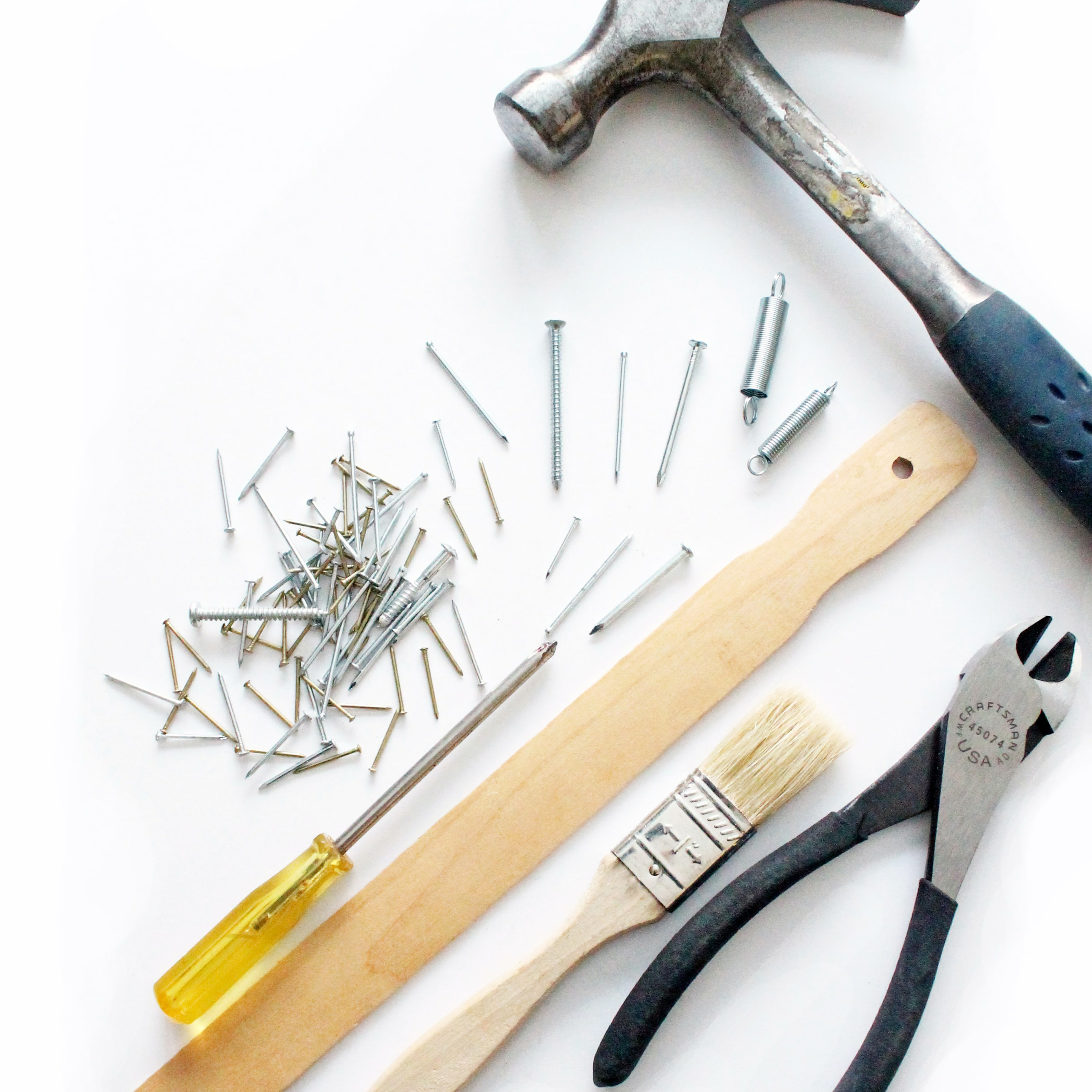
The claw hammer has a "claw" to pull nails out of wood, and is commonly found in an inventory of household tools in North America. Other types of hammer vary in shape, size, and structure, depending on their purposes.
Published: 7/30/2020
Hammers used in many trades include sledgehammers, mallets, and ball-peen hammers. Although most hammers are hand tools, powered hammers, such as steam hammers and trip hammers, are used to deliver forces beyond the capacity of the human arm.
Published: 3/12/2018
The first hammers were made without handles. Stones attached to sticks with strips of leather or animal sinew were being used as hammers with handles by about 30,000 BCE during the middle of the Paleolithic Stone Age.
Published: 8/10/2019
A traditional hand-held hammer consists of a separate head and a handle, which can be fastened together by means of a special wedge made for the purpose, or by glue, or both. This two-piece design is often used to combine a dense metallic striking head with a non-metallic mechanical-shock-absorbing handle (to reduce user fatigue from repeated strikes).
Published: 5/23/2020
f wood is used for the handle, it is often hickory or ash, which are tough and long-lasting materials that can dissipate shock waves from the hammer head.[2] Rigid fiberglass resin may be used for the handle; this material does not absorb water or decay but does not dissipate shock as well as wood.
Published: 2/28/2000
Some hammers are one-piece designs made mostly of a single material. A one-piece metallic hammer may optionally have its handle coated or wrapped in a resilient material such as rubber, for improved grip and to reduce user fatigue.
Published: 9/30/2027
The hammer head may be surfaced with a variety of materials including brass, bronze, wood, plastic, rubber, or leather. Some hammers have interchangeable striking surfaces, which can be selected as needed or replaced when worn out.
Published: 7/28/2014
A large hammer-like tool is a maul (sometimes called a "beetle"), a wood- or rubber-headed hammer is a mallet, and a hammer-like tool with a cutting blade is usually called a hatchet. The essential part of a hammer is the head, a compact solid mass that is able to deliver a blow to the intended target without itself deforming.
Published: 12/20/2020
The impacting surface of the tool is usually flat or slightly rounded; the opposite end of the impacting mass may have a ball shape, as in the ball-peen hammer. Some upholstery hammers have a magnetized face, to pick up tacks.
Published: 10/29/2020
In the swing that precedes each blow, the hammer head stores a certain amount of kinetic energy—equal to the length D of the swing times the force f produced by the muscles of the arm and by gravity. When the hammer strikes, the head is stopped by an opposite force coming from the target, equal and opposite to the force applied by the head to the target.
Published: 2/05/2001
If the target is a hard and heavy object, or if it is resting on some sort of anvil, the head can travel only a very short distance d before stopping. Since the stopping force F times that distance must be equal to the head's kinetic energy, it follows that F is much greater than the original driving force f—roughly, by a factor D/d.
Published: 12/12/1997